sam@mkd-led.com
8613794642383



OEM cooperation has become a core model in the lighting industry, allowing buyers to transform ideas into market-ready products with controlled cost and consistent quality. A well-managed OEM lighting project requires more than production capacity. It depends on structured processes, engineering capability, and communication efficiency across every stage.
From concept design to final delivery, experienced manufacturers follow a clear workflow to ensure that each product meets both technical requirements and market expectations.
The first step in any OEM project is understanding the product vision and technical requirements. This stage defines the direction of the entire development process.
Key inputs typically include:
Product type and application scenario
Target market and certification requirements
Design references or concept sketches
Performance expectations such as brightness, power, and lifespan
At this stage, manufacturers evaluate feasibility based on materials, structure, and cost. Clear communication helps avoid redesign delays later in the process.
For companies like MINGKEDA, which has over 41 years of experience in lighting manufacturing, early-stage evaluation ensures that both design intent and production reality are aligned before development begins.
Once requirements are confirmed, the project moves into custom lighting development. This phase involves transforming ideas into technical drawings and product structures.
Core tasks include:
Industrial design and appearance modeling
Structural engineering for durability and assembly
Electrical design for LED modules and drivers
Material selection for housing, finish, and components
Modern lighting products increasingly rely on integrated LED solutions, requiring close coordination between design and electrical teams. According to industry data from the U.S. Department of Energy, LED-based products dominate new lighting designs due to their efficiency and long lifespan, which influences how manufacturers approach product engineering.
MINGKEDA supports this stage with in-house design and engineering capabilities, enabling faster iteration and better control over product quality.
Before mass production, prototypes are developed to validate both design and performance. This is a critical step in the OEM lighting development process.
Prototype evaluation focuses on:
Structural stability and assembly accuracy
Light output, color consistency, and heat performance
Surface finish and visual appearance
Compliance with safety and electrical standards
Multiple rounds of sampling may be required, especially for complex or decorative products. Adjustments are made based on feedback to ensure the final product meets expectations.
Industry practice shows that proper prototyping can reduce mass production defects by more than 30 percent, according to manufacturing quality studies published by international industrial associations.
Testing ensures that the product meets safety, durability, and performance requirements for the target market. This stage is essential for export-oriented lighting products.
Typical tests include:
Electrical safety and insulation testing
Heat resistance and lifespan evaluation
Material durability and corrosion resistance
Light performance verification
Certifications such as CCC, UL, CE, and CB are often required depending on the destination market. MINGKEDA highlights its certification capabilities, which help streamline compliance for international projects.
Reliable testing not only ensures safety but also strengthens product credibility in competitive markets.
After prototype approval, the project enters full-scale lighting production. At this stage, process control becomes the main focus.
Production management includes:
Raw material inspection
Standardized assembly procedures
In-line quality checks during manufacturing
Final inspection before packaging
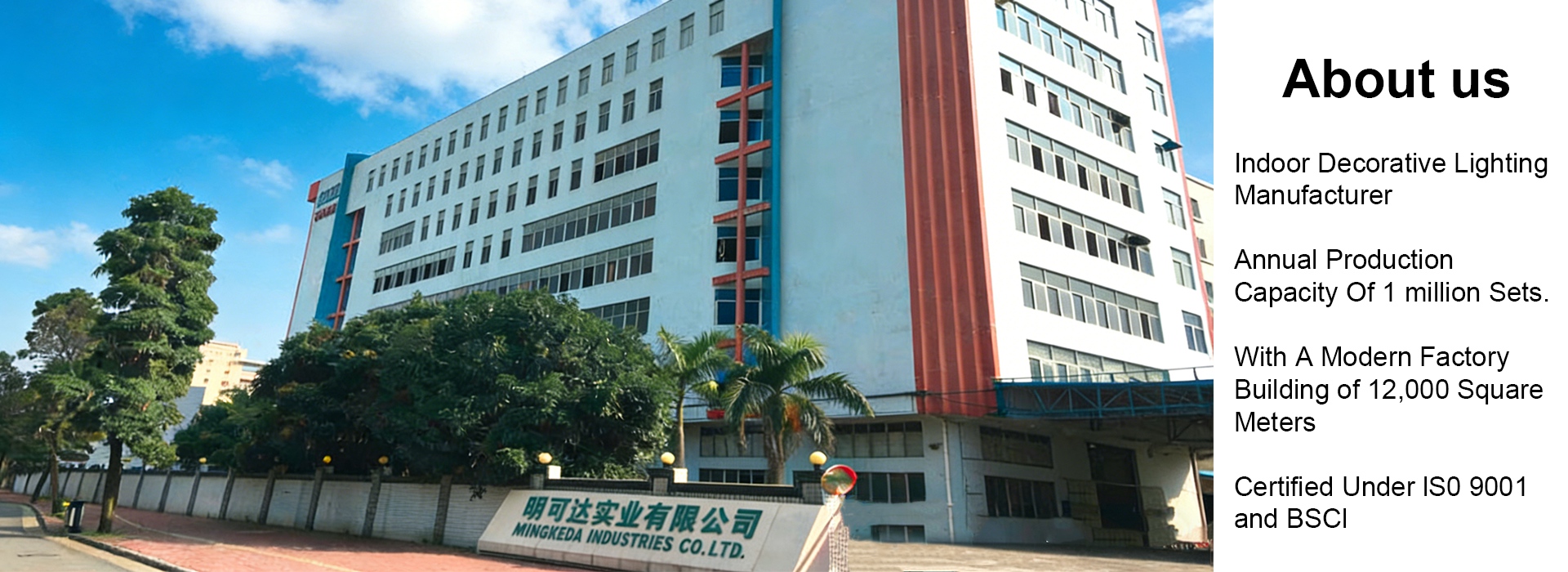
A stable production system ensures consistency across large orders. MINGKEDA operates a 12,000 square meter facility with over 200 employees, supporting scalable output and consistent quality control.
According to global manufacturing data, structured quality control systems can reduce defect rates to below 1 percent in well-managed production lines.
Packaging is an important part of OEM projects, especially for decorative lighting products that require protection during transportation.
Manufacturers typically provide:
Customized packaging design based on product size and market needs
Protective materials to prevent damage
Labeling and documentation for export compliance
Efficient logistics coordination ensures timely delivery and reduces the risk of delays. For international buyers, this stage directly impacts project schedules and inventory planning.
A well-executed OEM process provides several benefits:
Faster product development cycles
Better control over product differentiation
Consistent quality across production batches
Flexibility to adapt designs for different markets
With increasing demand for custom LED lamp manufacturing, structured OEM workflows allow manufacturers to deliver both standard and customized solutions efficiently.
Choosing the right partner is critical to OEM success. Beyond production capacity, a qualified manufacturer should offer:
Integrated design and engineering support
Proven experience in international markets
Strong quality management systems
Broad product categories for expansion opportunities
MINGKEDA combines design, production, and certification capabilities, making it well-suited for handling complex OEM projects across indoor lighting categories such as Pendant Lights, Floor Lamps, Wall Lamps, and decorative fixtures.
| Stage | Key Focus |
|---|---|
| Requirement confirmation | Define product scope and feasibility |
| Design development | Create structure, appearance, and electrical system |
| Prototyping | Validate performance and design details |
| Testing | Ensure safety and compliance |
| Mass production | Maintain consistency and efficiency |
| Packaging and delivery | Protect products and ensure timely shipment |
OEM lighting projects require a structured and disciplined approach from concept to delivery. Each stage plays a role in ensuring that the final product meets both design expectations and market standards.
Manufacturers with strong engineering, production, and quality control capabilities can significantly improve project outcomes. By combining experience, technical expertise, and scalable production, MINGKEDA provides a reliable foundation for successful OEM lighting development.
Previous: