sam@mkd-led.com
8613794642383



Bringing LED products to international markets is not just about design, brightness, or price. Certification plays a direct role in customs clearance, platform listing, project approval, and long-term brand credibility. For buyers, understanding LED lighting certification helps reduce compliance risk. For manufacturers, it is the foundation of stable exports and repeat business. According to the European Commission, light sources remain one of the largest product groups in Europe, with nearly 11 billion lamps in use in 2020, and lighting accounted for about 8 percent of primary energy considered in the 2020 assessment. That scale explains why compliance rules are strict and closely enforced.
A certified product moves more smoothly through the supply chain. It is easier to test, easier to declare, and easier to sell into retail, commercial, and project channels. Without the right approval marks, importers may face shipment delays, failed inspections, relabeling costs, or rejection by distributors. In practical terms, certifications required for LED lamps are not only about legal access. They also show that the product has been evaluated for electrical safety, electromagnetic compatibility, restricted substances, and in some cases energy efficiency.
The exact combination depends on the market and product type, but these are the certifications most buyers need to review.
CE lighting certification is essential for many LED products entering the European market. It is linked to compliance with applicable EU legislation, including electrical safety and electromagnetic compatibility. The European Commission states that CE marking can only be affixed after the product has been assessed under the relevant EU harmonisation rules. For LED lamps and luminaires, this often means reviewing the Low Voltage Directive, EMC requirements, RoHS restrictions, and energy-related rules where applicable.
For North America, UL lighting certification is one of the most recognized safety pathways. UL Solutions identifies common lighting standards such as UL 1598 for luminaires and UL 8750 for LED equipment used in lighting products. These standards are widely referenced for product safety evaluation in the United States and help buyers confirm that fixtures, drivers, and LED assemblies have been reviewed against relevant electrical and construction requirements.
Many LED products contain drivers, dimming circuits, controls, or wireless-related electronics that may fall under FCC requirements in the United States. The FCC states that RF devices must be properly authorized, and its enforcement guidance makes clear that manufacturers, importers, and marketers cannot lawfully market covered equipment without meeting the rules. For LED lighting, this matters especially for products with switching power supplies, smart controls, or digital components.
RoHS is critical in many export markets because it restricts hazardous substances in electrical and electronic equipment. The European Commission describes RoHS as a rule set designed to protect both the environment and public health by limiting hazardous substances in EEE. For LED lighting manufacturing, this affects solder, components, cables, plastics, coatings, and supply chain traceability. It is a core part of LED lighting compliance standards.
CB certification is especially useful when one product platform is intended for multiple markets. It supports international recognition of safety testing and can simplify market entry in countries that accept the CB Scheme. For lighting exporters, this often shortens the path to additional national approvals because the test basis is already aligned with recognized IEC standards. UL also notes that lighting certification work commonly relates to IEC 60598 requirements for luminaires.
For products sold domestically in China, CCC may apply depending on product scope and category. It is also often viewed by overseas buyers as an added signal of structured compliance management when the same factory handles both export and domestic programs. Mingkeda states that its LED lamps have obtained CCC certification, with some models also carrying UL, CB, and CE certification.
A certificate mark is only one part of the picture. Buyers should also ask which standards were used during testing. IEC 60598 is a key framework for luminaires, and the IEC states that this standard covers classification, marking, mechanical construction, electrical construction, and photobiological safety for luminaires up to 1,000 V. In the EU, ecodesign regulation also affects light sources by setting minimum performance requirements. From 1 September 2021, the EU regulation introduced declared power limits tied to useful luminous flux and color rendering.
| Market | Common certification focus | Why it matters |
|---|---|---|
| European Union | CE, RoHS, Ecodesign, Energy Label rules | Required for lawful entry and sale |
| United States | UL, FCC | Safety acceptance and interference compliance |
| Multiple export regions | CB | Helps support broader certification strategy |
| China | CCC | Supports domestic market access where applicable |
This table is a starting point, not a substitute for product-level review. A desk lamp, pendant light, rechargeable lamp, or smart ambient light may follow different compliance paths depending on voltage, driver type, wireless function, and application scenario.
Before placing an order, buyers should verify four points:
Whether the certification belongs to the exact model being purchased
Whether the test scope covers the complete product and not only a component
Whether EMC, material compliance, and labeling files are ready for shipment
Whether the factory can support OEM updates without invalidating certification
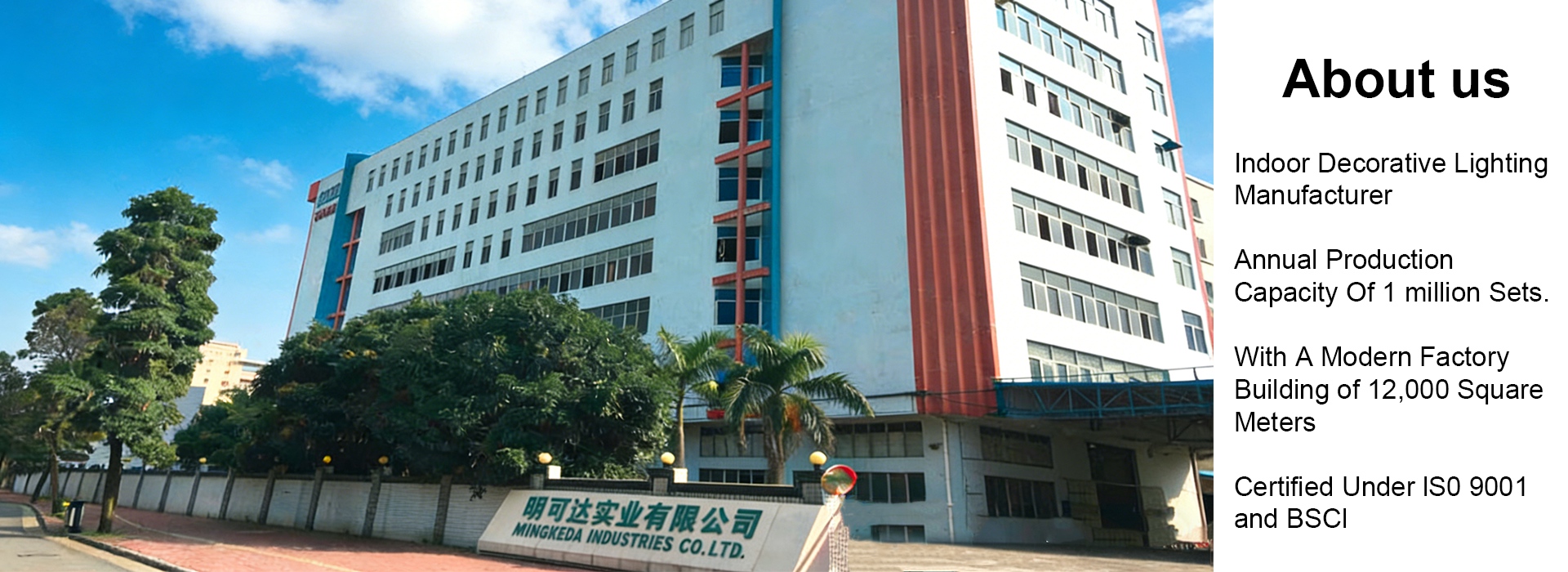
This is where strong lighting manufacturing capability matters. Mingkeda presents itself as a vertically integrated manufacturer with R&D, design, manufacturing, sales, and service under one system. The company states that it operates a 12,000 square meter facility, employs more than 200 people, maintains ISO 9001 and BSCI system certifications, and holds over 200 patents. Mingkeda also notes that key products carry CE, CCC, UL, and CB certifications, and that it established a dust-free production workshop in 2022 to strengthen production standards.
Certification is not a paperwork exercise. It influences product reliability, market acceptance, and after-sales stability. When a manufacturer understands CE lighting certification, UL lighting certification, and the full structure of LED lighting compliance standards, buyers gain clearer product positioning and fewer surprises after shipment. For companies sourcing decorative lamps, task lighting, ceiling lights, Wall Lamps, or rechargeable lamps, choosing a manufacturer with structured compliance capability can make the difference between a smooth launch and a costly delay. Mingkeda’s long experience in lighting, broad product range, and existing certification foundation give buyers a more dependable starting point for compliant LED product development.